Fall arrest vs fall restraint: what it means for the CHST
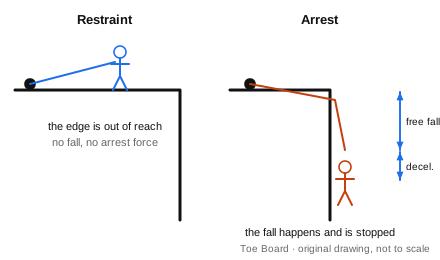
Fall restraint keeps a worker from reaching the edge at all: the lanyard is short enough, from a placed anchor, that the worker cannot get to the point where they could fall. Fall arrest lets the worker reach the edge and stops them after a fall begins. Restraint prevents the fall. Arrest limits the harm of one.
Fall arrest in the rules
A personal fall arrest system is anchor, connector and full body harness, often with a shock-absorbing lanyard or a self-retracting line. Under 29 CFR 1926.502(d), the system must limit the arresting force on the worker to 1,800 pounds with a body harness, limit free fall to 6 feet, keep the worker from contacting any lower level, and limit deceleration distance to 3.5 feet. Anchorages must hold 5,000 pounds per attached worker, or be designed by a qualified person with a safety factor of at least two. Body belts are not allowed as part of an arrest system.
The catch is clearance. Free fall, deceleration, harness stretch, the worker's height below the D-ring and a safety margin all add up, and the total must fit above the next level down. That arithmetic is what the fall clearance calculator does.
Try one question
Question 1 of the free 10-question check on CHST. No signup.
Emergency Preparedness, Incident Investigation, and Response
On a building under construction, what is the longest allowed travel distance from any point of the protected area to the nearest fire extinguisher?
Choose an answer to begin
Fall restraint in practice
Subpart M gives criteria for arrest systems and positioning devices in 1926.502(d) and (e); 1910.140 defines travel restraint. In plain terms, the idea of restraint is that the length is set so the edge cannot be reached from any point the worker can move to.
Positioning devices, used for example on rebar walls, are a third category under 1926.502(e): they hold a worker in place with both hands free, with free fall limited to 2 feet.
Ask Kick before you buy AI your Toe Board study buddy
See what's on the CHST exam, test yourself with 5 quick questions, or find the plan that fits you.
The CHST course
Available now · instant accessLearn each CHST blueprint domain, then prove it on two full-length timed practice exams.
- 4modules of lessonsEvery task on the outline
- 2full-length timed exams200 questions in 240 minutes each
- 440practice questionsEach one explained
- 1week-by-week study planSet to your exam date
Turn a practice answer into a study step. In untimed practice, ask Kick AI about any question you answer, follow up, then see your weakest topics and what to drill next.
Instant access. Terms and refunds · Secure checkout by Stripe
Every answer comes with a full explanation.
Which to choose
Where it works, restraint prevents the fall, so there is no arrest force. Read the hierarchy of controls the same way. Arrest is used where the worker must reach the edge. Both rank below collective protection that needs no action from the worker, such as a guardrail system. A toeboard protects people below from falling objects and is a separate duty.
Common mix-ups
- The same lanyard is not always both. A 6-foot lanyard that lets the worker reach the edge is arrest, not restraint.
- Arrest needs a rescue plan. Suspension after a fall is itself a hazard.
- Clearance is not the lanyard length. Add every distance.
On the CHST exam
Fall protection is one of the common hazards named in the hazard and risk identification and control domain, 36.6% of the CHST.
Practice it
The fall protection guide maps Subpart M. Every term in this set is in the CHST terms glossary.
Know the terms? Take the free 10-question check
Take the free 10-question check. It covers the four CHST domains, needs no signup and explains every answer, so you see which domain to study first. The CHST study guide shows where each topic fits in a six-week plan.
Not affiliated with or endorsed by BCSP.
Sources
Show the list
- 29 CFR 1926.502, Fall protection systems criteria and practices, OSHA.
- 29 CFR 1910.140, Personal fall protection systems, OSHA.
- CHST Examination Blueprint (CHST5, V.2022.04.12), Board of Certified Safety Professionals.
Facts checked 26 October 2026 against the sources listed above. If something has changed, tell us and we will correct it within 2 business days.
Your next step
Ready to see where you stand on CHST?
Free, untimed and scored by domain. No signup.
Start the free 10-question checkCHST course. Lessons, timed practice exams and a plan around your exam date. Get CHST course · $149 See the plans or read the free sample lesson.Terms and refunds