Lockout/tagout: what it means for the CHST
Lockout/tagout, often shortened to LOTO, is the practice of shutting off and isolating a machine's or circuit's energy sources, then putting a lock, a tag or both on the isolating device so nobody can turn it back on while work is under way. A lock physically prevents re-energizing. A tag only warns.
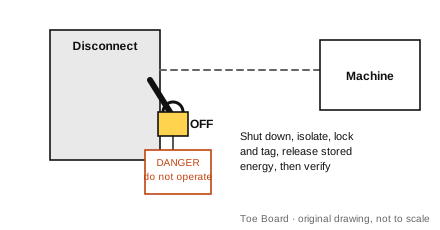
The usual steps
- Prepare. Know every energy source the equipment has: electrical, hydraulic, pneumatic, gravity, springs, heat, chemicals.
- Notify the people who use or work near the equipment.
- Shut down using the normal stop.
- Isolate each source at its disconnect, valve or block.
- Apply locks and tags. Each worker puts on their own lock, so nobody can remove protection for someone else.
- Release or restrain stored energy. Bleed pressure, block raised parts, discharge capacitors, let hot parts cool.
- Verify. Try the start control, and test circuits for absence of voltage, before touching anything.
Removal runs in reverse: check the area, account for every worker, then each person removes their own lock.
Try one question
Question 1 of the free 10-question check on CHST. No signup.
Emergency Preparedness, Incident Investigation, and Response
On a building under construction, what is the longest allowed travel distance from any point of the protected area to the nearest fire extinguisher?
Choose an answer to begin
Which rules apply in construction
The general industry rule, 29 CFR 1910.147, is the detailed LOTO standard, with written procedures, periodic inspections and training. Construction does not have a full counterpart. The construction electrical rule at 1926.417 covers lockout and tagging of circuits: controls are de-energized and tagged, and circuits are made safe before work. Other construction rules carry their own isolation duties, for example isolating hazards before permit space entry under Subpart AA. A contractor may adopt a written LOTO program modelled on 1910.147, because the hazards are the same.
Ask Kick before you buy AI your Toe Board study buddy
See what's on the CHST exam, test yourself with 5 quick questions, or find the plan that fits you.
The CHST course
Available now · instant accessLearn each CHST blueprint domain, then prove it on two full-length timed practice exams.
- 4modules of lessonsEvery task on the outline
- 2full-length timed exams200 questions in 240 minutes each
- 440practice questionsEach one explained
- 1week-by-week study planSet to your exam date
Turn a practice answer into a study step. In untimed practice, ask Kick AI about any question you answer, follow up, then see your weakest topics and what to drill next.
Instant access. Terms and refunds · Secure checkout by Stripe
Every answer comes with a full explanation.
Lock vs tag
A lock is the stronger control. A tag alone is acceptable in some cases under the rules when a lock cannot be fitted, and then extra measures are expected to give equal protection.
Common mix-ups
- Off is not isolated. A stop button can be bypassed or fail. Isolation is at the energy source.
- Forgetting stored energy. A raised bucket or a charged line can move after the switch is off.
- Skipping the verify step. The test is what proves the lockout worked.
- One lock for the crew. Each worker needs their own, or a group lockout method that gives the same protection.
On the CHST exam
Electrical hazards and controls are named in the hazard and risk domain, 36.6%. LOTO pairs naturally with GFCI vs assured grounding on temporary power, and with isolation before permit-required confined space entry.
Practice it
The electrical guide maps Subpart K section by section. Every term in this set is in the CHST terms glossary.
Know the terms? Take the free 10-question check
Take the free 10-question check. It covers the four CHST domains, needs no signup and explains every answer, so you see which domain to study first. The CHST study guide shows where each topic fits in a six-week plan.
Not affiliated with or endorsed by BCSP.
Sources
Show the list
- 29 CFR 1926.417, Lockout and tagging of circuits, OSHA.
- 29 CFR 1910.147, The control of hazardous energy, OSHA.
- CHST Examination Blueprint (CHST5, V.2022.04.12), Board of Certified Safety Professionals.
Facts checked 26 October 2026 against the sources listed above. If something has changed, tell us and we will correct it within 2 business days.
Your next step
Ready to see where you stand on CHST?
Free, untimed and scored by domain. No signup.
Start the free 10-question checkCHST course. Lessons, timed practice exams and a plan around your exam date. Get CHST course · $149 See the plans or read the free sample lesson.Terms and refunds