Silica Table 1: what it means for the CHST
Silica Table 1 is the table of specified exposure control methods in OSHA's construction silica standard, 29 CFR 1926.1153(c). It lists common dusty tasks, such as cutting with a handheld saw, and gives each one its engineering controls, work practices and any respirator required. An employer who follows a row fully does not have to measure exposure for that task.
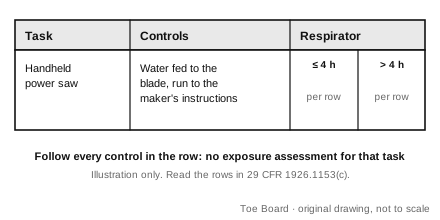
Two routes to compliance
The silica rule gives employers a choice for each task:
- Follow Table 1 fully. Use the listed controls exactly as described, maintain them, and provide the respirator the row calls for. No exposure assessment is needed for that task.
- Assess and control under paragraph (d). For tasks not in the table, or where the employer does not follow the row fully, the employer assesses exposure, by air sampling or objective data, and keeps it under the permissible exposure limit of 50 micrograms per cubic meter as an 8-hour average. The action level of 25 then matters for repeat monitoring.
Following part of a row does not count as following the table. Partial use puts you on the second route.
Try one question
Question 1 of the free 10-question check on CHST. No signup.
Emergency Preparedness, Incident Investigation, and Response
On a building under construction, what is the longest allowed travel distance from any point of the protected area to the nearest fire extinguisher?
Choose an answer to begin
What a row looks like
Each row names equipment and task, then the controls. Typical controls are water delivered to the blade or bit, a shroud with a dust collection system that meets stated airflow and filter conditions, or an enclosed cab with filtered air for heavy equipment. The respirator column is split by how long the task runs in a shift, 4 hours or less and more than 4 hours, and sometimes by whether the work is indoors or outdoors. Read the row in your own copy of the rule; we do not reproduce it here.
Ask Kick before you buy AI your Toe Board study buddy
See what's on the CHST exam, test yourself with 5 quick questions, or find the plan that fits you.
The CHST course
Available now · instant accessLearn each CHST blueprint domain, then prove it on two full-length timed practice exams.
- 4modules of lessonsEvery task on the outline
- 2full-length timed exams200 questions in 240 minutes each
- 440practice questionsEach one explained
- 1week-by-week study planSet to your exam date
Turn a practice answer into a study step. In untimed practice, ask Kick AI about any question you answer, follow up, then see your weakest topics and what to drill next.
Instant access. Terms and refunds · Secure checkout by Stripe
Every answer comes with a full explanation.
What else the rule requires
- A written exposure control plan, with a competent person who makes frequent and regular inspections.
- Housekeeping limits: dry sweeping and compressed air are restricted where they would raise dust and safer methods are feasible.
- Medical surveillance for workers required to wear a respirator for 30 or more days a year.
- Hazard communication and training on silica. See hazard communication.
Common mix-ups
- Table 1 is a shortcut, not a minimum. It replaces assessment only when followed completely.
- Water must actually reach the cut. A dry blade with a water line attached is not the control.
- The respirator column depends on time. The same task can need a respirator after 4 hours and not before.
- Engineering controls come first. The table builds in the hierarchy of controls: water or vacuum, then a respirator where still needed.
On the CHST exam
Silica is named in the hazard and risk identification and control domain, 36.6% of the CHST.
Practice it
Our health hazards guide sets silica beside lead and noise. Every term in this set is in the CHST terms glossary.
Know the terms? Take the free 10-question check
Take the free 10-question check. It covers the four CHST domains, needs no signup and explains every answer, so you see which domain to study first. The CHST study guide shows where each topic fits in a six-week plan.
Not affiliated with or endorsed by BCSP.
Sources
Show the list
- 29 CFR 1926.1153, Respirable Crystalline Silica, OSHA.
- Silica, Crystalline: Construction, OSHA.
- CHST Examination Blueprint (CHST5, V.2022.04.12), Board of Certified Safety Professionals.
Facts checked 26 October 2026 against the sources listed above. If something has changed, tell us and we will correct it within 2 business days.
Your next step
Ready to see where you stand on CHST?
Free, untimed and scored by domain. No signup.
Start the free 10-question checkCHST course. Lessons, timed practice exams and a plan around your exam date. Get CHST course · $149 See the plans or read the free sample lesson.Terms and refunds