GFCI vs assured grounding: what it means for the CHST
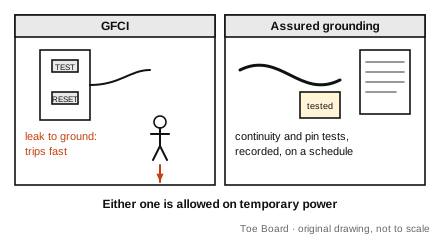
On construction sites, OSHA requires ground-fault protection for workers using temporary power, and gives two ways to provide it. A ground-fault circuit interrupter, or GFCI, cuts power within a fraction of a second when current leaks to ground. An assured equipment grounding conductor program instead tests and records cords and tools on a schedule.
Where the rule is
29 CFR 1926.404(b)(1) covers temporary 15 and 20 ampere, 120 volt receptacles that employees use and that are not part of the permanent wiring. Our electrical guide maps the rest of Subpart K.
How a GFCI works
A GFCI compares the current going out on the hot conductor with the current coming back on the neutral. If they differ by a small amount, some current is taking another path, possibly through a person, and the device opens the circuit very quickly. It does not need the equipment ground to be intact to protect the worker. It does not protect against a line-to-neutral shock, such as touching both conductors at once, and it is not an overcurrent device.
Try one question
Question 1 of the free 10-question check on CHST. No signup.
Emergency Preparedness, Incident Investigation, and Response
On a building under construction, what is the longest allowed travel distance from any point of the protected area to the nearest fire extinguisher?
Choose an answer to begin
What an assured grounding program requires
The program is the alternative where GFCIs are not used. In plain terms it needs:
- a written description of the program, kept on site,
- one or more competent persons to run it,
- a daily visual inspection of cord sets, attachment caps, plugs, receptacles and cord-connected equipment before use,
- tests for continuity of the equipment grounding conductor and correct attachment of the grounding conductor at each receptacle and plug,
- tests before first use, before returning repaired equipment to service, after any incident that may have caused damage, and at intervals of no more than 3 months, with longer intervals allowed for fixed cord sets not exposed to damage,
- a record of the tests, by a method such as logs or color coding.
Ask Kick before you buy AI your Toe Board study buddy
See what's on the CHST exam, test yourself with 5 quick questions, or find the plan that fits you.
The CHST course
Available now · instant accessLearn each CHST blueprint domain, then prove it on two full-length timed practice exams.
- 4modules of lessonsEvery task on the outline
- 2full-length timed exams200 questions in 240 minutes each
- 440practice questionsEach one explained
- 1week-by-week study planSet to your exam date
Turn a practice answer into a study step. In untimed practice, ask Kick AI about any question you answer, follow up, then see your weakest topics and what to drill next.
Instant access. Terms and refunds · Secure checkout by Stripe
Every answer comes with a full explanation.
Which is better
The GFCI acts automatically every time, and that is why it sits higher in the reasoning of the hierarchy of controls. The assured grounding program is administrative: it works only if the tests are done and recorded. Both are legal options under the rule. Neither replaces de-energizing and lockout/tagout when the work is on the circuit itself.
Common mix-ups
- A GFCI is not a breaker. It responds to imbalance, not overload.
- A missing ground pin is not fixed by a GFCI. The cord is still damaged and should come out of service.
- The program needs records. Tests done but not recorded do not show compliance.
On the CHST exam
Electrical hazards sit in the hazard and risk identification and control domain, 36.6% of the CHST. Temporary power also feeds welding and cutting, covered in hot work.
Practice it
Every term in this set is in the CHST terms glossary.
Know the terms? Take the free 10-question check
Take the free 10-question check. It covers the four CHST domains, needs no signup and explains every answer, so you see which domain to study first. The CHST study guide shows where each topic fits in a six-week plan.
Not affiliated with or endorsed by BCSP.
Sources
Show the list
- 29 CFR 1926.404, Wiring design and protection, OSHA.
- CHST Examination Blueprint (CHST5, V.2022.04.12), Board of Certified Safety Professionals.
Facts checked 26 October 2026 against the sources listed above. If something has changed, tell us and we will correct it within 2 business days.
Your next step
Ready to see where you stand on CHST?
Free, untimed and scored by domain. No signup.
Start the free 10-question checkCHST course. Lessons, timed practice exams and a plan around your exam date. Get CHST course · $149 See the plans or read the free sample lesson.Terms and refunds