Qualified rigger: what it means for the CHST
A qualified rigger, in OSHA's crane rule, is a rigger who meets the qualified-person test: proven knowledge, training and experience in rigging, shown by solving rigging problems. Subpart CC does not require a card or a set course, only that the person can actually do the rigging.
When a qualified rigger is required
Two places in 29 CFR 1926 Subpart CC name the qualified rigger:
- Assembly and disassembly. Rigging work during assembly or disassembly of the crane is done by a qualified rigger, under 1926.1404(r).
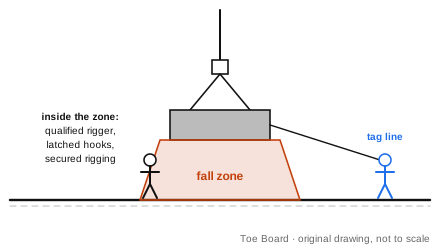
- Work in the fall zone. Under 1926.1425, when workers are hooking, unhooking or guiding a load, or making its initial connection to a structure, and they are within the fall zone, the load must be rigged to prevent it slipping or shifting, hooks need self-closing latches or an equivalent, and the materials must be rigged by a qualified rigger.
Outside those cases, the general rule is to keep workers out of the fall zone altogether.
Try one question
Question 1 of the free 10-question check on CHST. No signup.
Emergency Preparedness, Incident Investigation, and Response
On a building under construction, what is the longest allowed travel distance from any point of the protected area to the nearest fire extinguisher?
Choose an answer to begin
The rigging terms around it
- Fall zone. The area where it is reasonably foreseeable that a partly or fully suspended load could fall if something went wrong, including but not only the area directly under the load. It is defined in 1926.1401.
- Tag line. A rope attached to the load and held by a worker to control swing and rotation, keeping their hands off the load and their body away from it.
- Working load limit. The most a sling or fitting may carry in service, as rated by its maker. It goes down as the sling angle flattens.
- Qualified signal person. The person giving signals to the operator when signals are required, qualified under 1926.1428.
- Competent person. Rigging equipment is inspected before use on each shift under 1926.251(a)(1); the competent person is named for specific sling types, such as alloy steel chain slings in 1926.251(b). See competent vs qualified person for the difference.
Ask Kick before you buy AI your Toe Board study buddy
See what's on the CHST exam, test yourself with 5 quick questions, or find the plan that fits you.
The CHST course
Available now · instant accessLearn each CHST blueprint domain, then prove it on two full-length timed practice exams.
- 4modules of lessonsEvery task on the outline
- 2full-length timed exams200 questions in 240 minutes each
- 440practice questionsEach one explained
- 1week-by-week study planSet to your exam date
Turn a practice answer into a study step. In untimed practice, ask Kick AI about any question you answer, follow up, then see your weakest topics and what to drill next.
Instant access. Terms and refunds · Secure checkout by Stripe
Every answer comes with a full explanation.
Planning the lift
A lift plan or job hazard analysis for a pick names who rigs, who signals, where the fall zone is and how people stay out of it. The plan is also where power line clearance and the swing radius of the crane are settled before anyone rigs.
Common mix-ups
- Qualified rigger is not a certification title. It is a capability the employer must be able to show.
- The fall zone is not only under the load. It covers where the load could foreseeably fall.
- A tag line does not make it safe to stand under the load.
On the CHST exam
Cranes and rigging are among the common hazards in the hazard and risk identification and control domain, 36.6% of the CHST.
Practice it
Our cranes and derricks guide maps Subpart CC section by section. Every term in this set is in the CHST terms glossary.
Know the terms? Take the free 10-question check
Take the free 10-question check. It covers the four CHST domains, needs no signup and explains every answer, so you see which domain to study first. The CHST study guide shows where each topic fits in a six-week plan.
Not affiliated with or endorsed by BCSP.
Sources
Show the list
- 29 CFR 1926 Subpart CC, Cranes and Derricks in Construction, OSHA.
- 29 CFR 1926.251, Rigging equipment for material handling, OSHA.
- CHST Examination Blueprint (CHST5, V.2022.04.12), Board of Certified Safety Professionals.
Facts checked 26 October 2026 against the sources listed above. If something has changed, tell us and we will correct it within 2 business days.
Your next step
Ready to see where you stand on CHST?
Free, untimed and scored by domain. No signup.
Start the free 10-question checkCHST course. Lessons, timed practice exams and a plan around your exam date. Get CHST course · $149 See the plans or read the free sample lesson.Terms and refunds