Hierarchy of controls: what it means for the CHST
The hierarchy of controls is a ranking of ways to deal with a hazard, from most to least effective: elimination, substitution, engineering controls, administrative controls and personal protective equipment. Higher controls depend less on people getting it right every time, so use the highest one that is feasible.
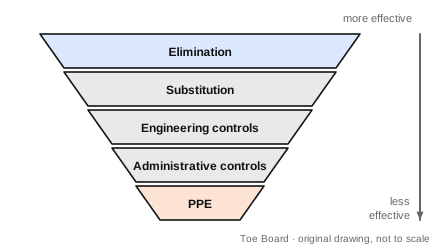
The five levels with site examples
- Elimination removes the hazard. Prefabricate a roof truss assembly on the ground so nobody works at height to assemble it.
- Substitution swaps in something less hazardous. Use a water-based coating instead of a solvent-based one.
- Engineering controls separate people from the hazard by design. A guardrail at an open edge, a shroud and vacuum on a grinder, or a trench shield.
- Administrative controls change how people work. A permit system, a rotation that limits time in a noisy area, training, signs and warning lines.
- PPE protects the individual worker. A harness, a respirator, hearing protection, gloves.
Try one question
Question 1 of the free 10-question check on CHST. No signup.
Emergency Preparedness, Incident Investigation, and Response
On a building under construction, what is the longest allowed travel distance from any point of the protected area to the nearest fire extinguisher?
Choose an answer to begin
Why the order matters
Each level down relies more on behavior and on equipment being worn and worn correctly. A guardrail works when the crew is tired. A harness only works if it is worn, fitted, inspected and tied to a suitable anchor. That is why a choice between a guardrail and a harness, with both feasible, goes to the guardrail.
OSHA rules often build the hierarchy in. The lead rule at 1926.62 asks for engineering and work practice controls before respirators, and the noise rule at 1926.52 asks for feasible engineering or administrative controls before hearing protection. The health hazards guide walks through both.
Ask Kick before you buy AI your Toe Board study buddy
See what's on the CHST exam, test yourself with 5 quick questions, or find the plan that fits you.
The CHST course
Available now · instant accessLearn each CHST blueprint domain, then prove it on two full-length timed practice exams.
- 4modules of lessonsEvery task on the outline
- 2full-length timed exams200 questions in 240 minutes each
- 440practice questionsEach one explained
- 1week-by-week study planSet to your exam date
Turn a practice answer into a study step. In untimed practice, ask Kick AI about any question you answer, follow up, then see your weakest topics and what to drill next.
Instant access. Terms and refunds · Secure checkout by Stripe
Every answer comes with a full explanation.
Feasible is the key word
The hierarchy does not say always eliminate. It says use the highest control that can actually be done for this task. Several layers are usually combined: a shroud and vacuum on a saw, plus a respirator for long tasks, is a common pairing on silica work. The point is that the lower layer backs up the upper one rather than replacing it.
Common mix-ups
- Training is administrative, not engineering. It changes behavior, not the equipment.
- A warning sign is administrative. It does not stop anyone.
- PPE is not wrong. It is the last layer, used when higher controls are not enough or during the time they are being put in place.
On the CHST exam
Applying a hierarchy of controls sits in the hazard and risk identification and control domain, 36.6% of the CHST. When two options both reduce risk, pick the one higher on the list. A job hazard analysis is where you apply it step by step, and the permissible exposure limit is the line the controls must keep exposure under. Our blog has more hierarchy of controls examples.
Practice it
The free hierarchy of controls drill gives you 20 original construction scenarios. You rank four controls or pick the strongest one the job allows, then see each control's level and the OSHA section behind it. All twenty terms are in the CHST terms glossary.
Know the terms? Take the free 10-question check
Take the free 10-question check. It covers the four CHST domains, needs no signup and explains every answer, so you see which domain to study first. The CHST study guide shows where each topic fits in a six-week plan.
Not affiliated with or endorsed by BCSP.
Sources
Show the list
- Hierarchy of Controls, NIOSH.
- 29 CFR 1926.62, Lead and 1926.52, Occupational noise exposure, OSHA.
- CHST Examination Blueprint (CHST5, V.2022.04.12), Board of Certified Safety Professionals.
Facts checked 26 October 2026 against the sources listed above. If something has changed, tell us and we will correct it within 2 business days.
Your next step
Ready to see where you stand on CHST?
Free, untimed and scored by domain. No signup.
Start the free 10-question checkCHST course. Lessons, timed practice exams and a plan around your exam date. Get CHST course · $149 See the plans or read the free sample lesson.Terms and refunds