Excavation protective systems: what it means for the CHST
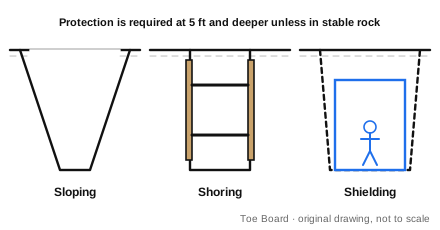
An excavation protective system is anything that protects workers in a trench or excavation from a cave-in. OSHA recognizes three families: sloping or benching the walls back, supporting the walls with shoring, and shielding the workers with a trench box. The choice depends on soil type, depth, water, nearby loads and the room available on site.
When one is required
Under 29 CFR 1926.652, a protective system is required unless the excavation is in stable rock, or is less than 5 feet deep and a competent person examines it and finds no sign of a possible cave-in. Deeper than 20 feet, sloping and support systems must be designed by a registered professional engineer (Subpart P, Appendix F). Our excavations guide maps the rest of Subpart P.
Try one question
Question 1 of the free 10-question check on CHST. No signup.
Emergency Preparedness, Incident Investigation, and Response
On a building under construction, what is the longest allowed travel distance from any point of the protected area to the nearest fire extinguisher?
Choose an answer to begin
The three families
- Sloping and benching cut the walls back so the soil has nothing to slide into. The allowable angle depends on soil type: the appendices classify soil as stable rock or one of three types, A, B and C, from strongest to weakest. A competent person classifies the soil by visual and manual tests. Benching cuts the slope into steps and is not allowed in Type C soil.
- Shoring holds the walls in place with uprights, wales and cross braces, made of timber or aluminum hydraulic members. It prevents movement.
- Shielding uses a trench box that does not stop the walls moving but protects the people inside it if they do. Workers stay inside the shield and are not in it while it is installed, moved or removed.
Ask Kick before you buy AI your Toe Board study buddy
See what's on the CHST exam, test yourself with 5 quick questions, or find the plan that fits you.
The CHST course
Available now · instant accessLearn each CHST blueprint domain, then prove it on two full-length timed practice exams.
- 4modules of lessonsEvery task on the outline
- 2full-length timed exams200 questions in 240 minutes each
- 440practice questionsEach one explained
- 1week-by-week study planSet to your exam date
Turn a practice answer into a study step. In untimed practice, ask Kick AI about any question you answer, follow up, then see your weakest topics and what to drill next.
Instant access. Terms and refunds · Secure checkout by Stripe
Every answer comes with a full explanation.
Design options
The rule offers several ways to design each system: the appendix tables, the manufacturer's tabulated data, other tabulated data from a registered engineer, or a design by a registered engineer. The more you depart from the simple tables, the more an engineer is involved.
Common mix-ups
- 4 feet and 5 feet are different triggers. A way out within 25 feet of lateral travel is needed at 4 feet deep; the protective system rule starts at 5 feet.
- A trench box protects only inside it. Walls outside the box can still collapse.
- Spoil at the edge is a load. Keep it back at least 2 feet, per 1926.651.
- Rain changes the soil. The competent person re-inspects after anything that changes conditions. See competent vs qualified person.
- A trench can also be a hazardous atmosphere. Testing may be needed where low oxygen or gas could collect, the same reasoning as a permit-required confined space.
On the CHST exam
Excavations are one of the common construction hazards named in the hazard and risk identification and control domain, 36.6% of the CHST.
Practice it
The trench sloping calculator turns a depth and soil type into a slope and top width. Every term in this set is in the CHST terms glossary.
Know the terms? Take the free 10-question check
Take the free 10-question check. It covers the four CHST domains, needs no signup and explains every answer, so you see which domain to study first. The CHST study guide shows where each topic fits in a six-week plan.
Not affiliated with or endorsed by BCSP.
Sources
Show the list
- 29 CFR 1926 Subpart P, Excavations, OSHA.
- CHST Examination Blueprint (CHST5, V.2022.04.12), Board of Certified Safety Professionals.
Facts checked 26 October 2026 against the sources listed above. If something has changed, tell us and we will correct it within 2 business days.
Your next step
Ready to see where you stand on CHST?
Free, untimed and scored by domain. No signup.
Start the free 10-question checkCHST course. Lessons, timed practice exams and a plan around your exam date. Get CHST course · $149 See the plans or read the free sample lesson.Terms and refunds