Time-weighted average: what it means for the CHST
A time-weighted average, or TWA, is a worker's exposure averaged over a reference period, almost always an 8-hour shift. Each measured level is multiplied by the time spent at it, the products are added, and the sum is divided by 8. The result can be compared directly with an 8-hour permissible exposure limit or action level.
The formula for airborne exposure
TWA = (C1 T1 + C2 T2 + ... + Cn Tn) / 8
C is the concentration measured during a period and T is the length of that period in hours. Time with no exposure still counts in the 8: it adds zero to the top and the full 8 stays on the bottom. If the shift is longer than 8 hours, the sum is still divided by 8 for an 8-hour TWA, which is why long shifts push the average up.
Try one question
Question 1 of the free 10-question check on CHST. No signup.
Emergency Preparedness, Incident Investigation, and Response
On a building under construction, what is the longest allowed travel distance from any point of the protected area to the nearest fire extinguisher?
Choose an answer to begin
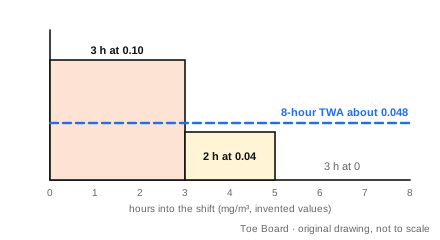
A worked dust example with invented numbers
A laborer runs a dusty task for 3 hours at 0.10 mg/m3, does cleanup for 2 hours at 0.04 mg/m3 and spends the last 3 hours with no measurable exposure.
- 0.10 x 3 = 0.30
- 0.04 x 2 = 0.08
- Sum: 0.38, divided by 8 = 0.0475 mg/m3
The peak was 0.10, but the 8-hour TWA is under half that. If the limit were 0.05 as an 8-hour TWA, the worker would be just under it, close enough that it would be worth controlling.
Ask Kick before you buy AI your Toe Board study buddy
See what's on the CHST exam, test yourself with 5 quick questions, or find the plan that fits you.
The CHST course
Available now · instant accessLearn each CHST blueprint domain, then prove it on two full-length timed practice exams.
- 4modules of lessonsEvery task on the outline
- 2full-length timed exams200 questions in 240 minutes each
- 440practice questionsEach one explained
- 1week-by-week study planSet to your exam date
Turn a practice answer into a study step. In untimed practice, ask Kick AI about any question you answer, follow up, then see your weakest topics and what to drill next.
Instant access. Terms and refunds · Secure checkout by Stripe
Every answer comes with a full explanation.
Noise uses a dose instead
Noise does not average the same way, because each 5 dBA step halves the allowed time under OSHA's table. You first work a dose: D = 100 times the sum of (hours at a level divided by the hours allowed at that level). A dose of 100 percent equals an 8-hour TWA of 90 dBA. Our CHST formulas guide works the conversion from dose to TWA step by step.
Invented example: 4 hours at 90 dBA, where 8 hours are allowed, and 2 hours at 95 dBA, where 4 are allowed. The dose is 100 times (0.5 plus 0.5), or 100 percent, an 8-hour TWA of exactly 90 dBA.
Common mix-ups
- Dividing by the hours sampled. For an 8-hour TWA, divide by 8, not by the 5 hours you happened to sample, unless you have a reason to assume the unsampled time was the same.
- Comparing the peak with a TWA limit. Short peaks belong against a short-term or ceiling limit.
- Averaging decibels. Sound levels are logarithmic; use the dose method.
On the CHST exam
TWA and dose arithmetic sit in the hazard and risk identification and control domain, 36.6% of the CHST. Keep the result beside its permissible exposure limit and action level as you work each example.
Practice it
Work your own shifts in the noise dose calculator, then check the rest of this set in the CHST terms glossary.
Know the terms? Take the free 10-question check
Take the free 10-question check. It covers the four CHST domains, needs no signup and explains every answer, so you see which domain to study first. The CHST study guide shows where each topic fits in a six-week plan.
Not affiliated with or endorsed by BCSP.
Sources
Show the list
- 29 CFR 1926.52, Occupational noise exposure, OSHA.
- 29 CFR 1926.55, Gases, vapors, fumes, dusts, and mists, OSHA.
- CHST Examination Blueprint (CHST5, V.2022.04.12), Board of Certified Safety Professionals.
Facts checked 26 October 2026 against the sources listed above. If something has changed, tell us and we will correct it within 2 business days.
Your next step
Ready to see where you stand on CHST?
Free, untimed and scored by domain. No signup.
Start the free 10-question checkCHST course. Lessons, timed practice exams and a plan around your exam date. Get CHST course · $149 See the plans or read the free sample lesson.Terms and refunds