Competent vs qualified person: what it means for the CHST
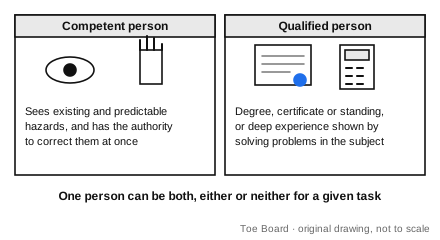
A competent person, in OSHA's construction rules, is someone who can recognize existing and predictable hazards on the job and has the employer's authority to correct them right away. A qualified person has a degree, certificate or professional standing, or deep knowledge and experience, and has shown they can solve problems in a specific subject.
Where the two definitions live
Both terms are defined in 29 CFR 1926.32: the competent person in paragraph (f) and the qualified person in paragraph (m). The individual subparts then name one or the other for each duty. Read the subpart that applies, because the role is assigned by the duty, not by job title. A foreman can be the competent person for a trench and still not be the qualified person who designs its shoring.
Try one question
Question 1 of the free 10-question check on CHST. No signup.
Emergency Preparedness, Incident Investigation, and Response
On a building under construction, what is the longest allowed travel distance from any point of the protected area to the nearest fire extinguisher?
Choose an answer to begin
The test for each role
The competent person has two halves, and both must be true. First, knowledge: they can tell what is dangerous in the work in front of them, including hazards that are not there yet but will be. Second, authority: they have authorization to take prompt corrective measures. A worker who spots a hazard but has to call the office before acting is not the competent person.
The qualified person is about proven ability in a subject. Credentials help, but OSHA also accepts extensive knowledge, training and experience backed by a track record of solving problems in that area. There is no authority half. A qualified engineer may design something and never set foot on site.
Ask Kick before you buy AI your Toe Board study buddy
See what's on the CHST exam, test yourself with 5 quick questions, or find the plan that fits you.
The CHST course
Available now · instant accessLearn each CHST blueprint domain, then prove it on two full-length timed practice exams.
- 4modules of lessonsEvery task on the outline
- 2full-length timed exams200 questions in 240 minutes each
- 440practice questionsEach one explained
- 1week-by-week study planSet to your exam date
Turn a practice answer into a study step. In untimed practice, ask Kick AI about any question you answer, follow up, then see your weakest topics and what to drill next.
Instant access. Terms and refunds · Secure checkout by Stripe
Every answer comes with a full explanation.
Examples on a site
- Excavations. A competent person inspects the trench each day and after rain, and removes workers if they see signs of a cave-in. See excavation protective systems.
- Scaffolds. A competent person supervises erection and inspects before each shift. A qualified person designs certain scaffolds.
- Cranes. Subpart CC names both, and adds the qualified rigger and the qualified signal person for specific tasks.
- Fall protection. Training under 1926.503 is given by a competent person, and some anchorages are designed under the supervision of a qualified person.
Common mix-ups
- Training alone does not make someone competent. Without authority to act, the knowledge half is not enough.
- Qualified is not a higher rank of competent. They are different roles, and one person may hold one, both or neither for a given task.
- A certificate card does not settle it. The employer designates the person, and the rule asks what they can do.
On the CHST exam
The CHST blueprint does not name this term. Roles and responsibilities under the standards appear in the program domain (22.5%), and the hazard topics in the 36.6% domain are where each rule assigns one of the roles. For a longer walk-through with more subparts, read competent person vs qualified person on our blog.
Practice it
The excavations guide shows the competent person at work in a trench. Every term in this set is listed in the CHST terms glossary.
Know the terms? Take the free 10-question check
Take the free 10-question check. It covers the four CHST domains, needs no signup and explains every answer, so you see which domain to study first. The CHST study guide shows where each topic fits in a six-week plan.
Not affiliated with or endorsed by BCSP.
Sources
Show the list
- 29 CFR 1926.32, Definitions, OSHA.
- CHST Examination Blueprint (CHST5, V.2022.04.12), Board of Certified Safety Professionals.
Facts checked 26 October 2026 against the sources listed above. If something has changed, tell us and we will correct it within 2 business days.
Your next step
Ready to see where you stand on CHST?
Free, untimed and scored by domain. No signup.
Start the free 10-question checkCHST course. Lessons, timed practice exams and a plan around your exam date. Get CHST course · $149 See the plans or read the free sample lesson.Terms and refunds