Permissible exposure limit: what it means for the CHST
A permissible exposure limit, or PEL, is the legal maximum amount of a chemical, dust or physical agent such as noise that OSHA allows a worker to be exposed to. Many PELs are written as an 8-hour time-weighted average, so short peaks are allowed as long as the average over the shift stays at or under the limit.
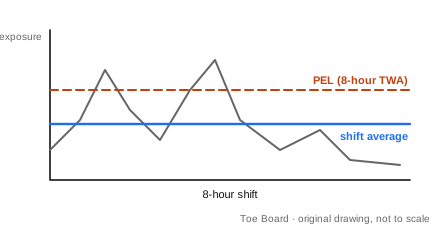
Where the numbers live
For construction, the general table of airborne limits is in 29 CFR 1926.55 and its appendix. Substances with their own full standards carry their own PEL inside that standard: respirable crystalline silica in 1926.1153, lead in 1926.62 and asbestos in 1926.1101, among others. Noise is in 1926.52, as a table of allowed hours at each sound level starting at 90 dBA for 8 hours.
Our health hazards guide gives the silica and lead figures: both have a PEL of 50 micrograms per cubic meter as an 8-hour average.
Try one question
Question 1 of the free 10-question check on CHST. No signup.
Emergency Preparedness, Incident Investigation, and Response
On a building under construction, what is the longest allowed travel distance from any point of the protected area to the nearest fire extinguisher?
Choose an answer to begin
Three kinds of limit
- Time-weighted average. The average over a full shift, the most common form. See time-weighted average for the arithmetic.
- Short-term exposure limit. An average over a short window, usually 15 minutes, for substances where brief high exposure matters.
- Ceiling. A level that must not be exceeded at any moment.
A substance can carry more than one. Read which kind a limit is before comparing a sample result with it.
Ask Kick before you buy AI your Toe Board study buddy
See what's on the CHST exam, test yourself with 5 quick questions, or find the plan that fits you.
The CHST course
Available now · instant accessLearn each CHST blueprint domain, then prove it on two full-length timed practice exams.
- 4modules of lessonsEvery task on the outline
- 2full-length timed exams200 questions in 240 minutes each
- 440practice questionsEach one explained
- 1week-by-week study planSet to your exam date
Turn a practice answer into a study step. In untimed practice, ask Kick AI about any question you answer, follow up, then see your weakest topics and what to drill next.
Instant access. Terms and refunds · Secure checkout by Stripe
Every answer comes with a full explanation.
What a PEL is not
A PEL is a legal floor for compliance, not a line between safe and harmful. Many of OSHA's general air limits were adopted around 1970 and have not been updated, and OSHA itself points employers to newer recommended limits from NIOSH and other bodies. Many substance standards also set an action level, a lower number that switches on monitoring and medical duties before the PEL is reached.
Common mix-ups
- Comparing a 15-minute sample with an 8-hour limit. Match the sample period to the type of limit.
- Treating a respirator as meeting the PEL. The PEL is about the air in the worker's breathing zone. Controls come first under the hierarchy, and respirators are used when those are not enough.
- Using the general industry table for construction. The rules are in different parts. Cite Part 1926 on a construction site.
On the CHST exam
Exposure limits sit in the hazard and risk identification and control domain, 36.6% of the CHST, with silica, lead, noise and chemicals all named in its knowledge list.
Practice it
Noise is the easiest PEL to work by hand. Try the noise dose calculator, which turns hours at each sound level into a dose and an 8-hour TWA. All twenty terms are in the CHST terms glossary.
Know the terms? Take the free 10-question check
Take the free 10-question check. It covers the four CHST domains, needs no signup and explains every answer, so you see which domain to study first. The CHST study guide shows where each topic fits in a six-week plan.
Not affiliated with or endorsed by BCSP.
Sources
Show the list
- Permissible Exposure Limits, OSHA.
- 29 CFR 1926.55, Gases, vapors, fumes, dusts, and mists, OSHA.
- CHST Examination Blueprint (CHST5, V.2022.04.12), Board of Certified Safety Professionals.
Facts checked 26 October 2026 against the sources listed above. If something has changed, tell us and we will correct it within 2 business days.
Your next step
Ready to see where you stand on CHST?
Free, untimed and scored by domain. No signup.
Start the free 10-question checkCHST course. Lessons, timed practice exams and a plan around your exam date. Get CHST course · $149 See the plans or read the free sample lesson.Terms and refunds