Guardrail system: what it means for the CHST
A guardrail system is a barrier built along an unprotected side or edge to stop people from falling to a lower level. It is made of a top rail, an intermediate member such as a midrail, screen or mesh, and the posts that hold them. It protects everyone near the edge with nothing to wear or clip on.
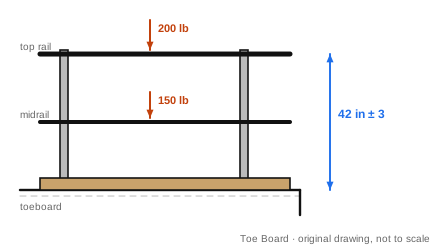
The numbers in 1926.502(b)
In our own words, the criteria for guardrail systems in construction are:
- Top rail height: 42 inches, plus or minus 3 inches, above the walking or working level. It may be higher if everything else is met.
- Top rail strength: it must withstand a 200-pound force applied within 2 inches of the top edge, outward or downward, and it must not deflect to below 39 inches under that force.
- Midrails (or screens, mesh or intermediate members) are needed where there is no wall or parapet at least 21 inches high. A midrail goes midway between the top rail and the walking level and must withstand 150 pounds.
- Openings: screens and intermediate vertical members leave no opening wider than 19 inches.
- Materials: rails are at least a quarter inch thick, so nothing cuts a hand, and steel or plastic banding is not used as a rail. A wire rope top rail is flagged with high-visibility material at intervals of no more than 6 feet.
Try one question
Question 1 of the free 10-question check on CHST. No signup.
Emergency Preparedness, Incident Investigation, and Response
On a building under construction, what is the longest allowed travel distance from any point of the protected area to the nearest fire extinguisher?
Choose an answer to begin
Where guardrails are used
Open sides of floors and roofs, wall openings, hoist areas, ramps and runways, holes and the edges of excavations where people could fall in. Scaffolds have their own guardrail criteria in Subpart L, and the scaffolds guide points to them.
Ask Kick before you buy AI your Toe Board study buddy
See what's on the CHST exam, test yourself with 5 quick questions, or find the plan that fits you.
The CHST course
Available now · instant accessLearn each CHST blueprint domain, then prove it on two full-length timed practice exams.
- 4modules of lessonsEvery task on the outline
- 2full-length timed exams200 questions in 240 minutes each
- 440practice questionsEach one explained
- 1week-by-week study planSet to your exam date
Turn a practice answer into a study step. In untimed practice, ask Kick AI about any question you answer, follow up, then see your weakest topics and what to drill next.
Instant access. Terms and refunds · Secure checkout by Stripe
Every answer comes with a full explanation.
Why it wins over a harness
On the hierarchy of controls, a guardrail is an engineering control: it works whether or not the worker remembers anything. A personal system depends on fit, inspection and a good anchor. That is why, with both feasible, a guardrail is the better answer. See fall arrest vs fall restraint for the personal options.
Common mix-ups
- A guardrail does not stop falling objects. That is the job of a toeboard, screen or canopy.
- The 42 inches is measured to the top edge, from the surface the worker stands on.
- A chain or rope can be a top rail only if it meets the same height, strength and deflection criteria.
- Removing a section for material handling leaves an open edge that needs other protection while it is open.
On the CHST exam
Fall protection is one of the common hazards named in the hazard and risk identification and control domain, 36.6% of the CHST.
Practice it
The fall protection guide maps Subpart M section by section. Every term in this set is in the CHST terms glossary.
Know the terms? Take the free 10-question check
Take the free 10-question check. It covers the four CHST domains, needs no signup and explains every answer, so you see which domain to study first. The CHST study guide shows where each topic fits in a six-week plan.
Not affiliated with or endorsed by BCSP.
Sources
Show the list
- 29 CFR 1926.502, Fall protection systems criteria and practices, OSHA.
- CHST Examination Blueprint (CHST5, V.2022.04.12), Board of Certified Safety Professionals.
Facts checked 26 October 2026 against the sources listed above. If something has changed, tell us and we will correct it within 2 business days.
Your next step
Ready to see where you stand on CHST?
Free, untimed and scored by domain. No signup.
Start the free 10-question checkCHST course. Lessons, timed practice exams and a plan around your exam date. Get CHST course · $149 See the plans or read the free sample lesson.Terms and refunds