TRIR vs DART: what it means for the CHST
TRIR, the total recordable incident rate, is the number of OSHA recordable injuries and illnesses per 200,000 hours worked. The DART rate uses the same formula but counts only the cases that caused days away from work, restricted duty or a job transfer. DART is always a subset of TRIR, so it can never be the larger number.
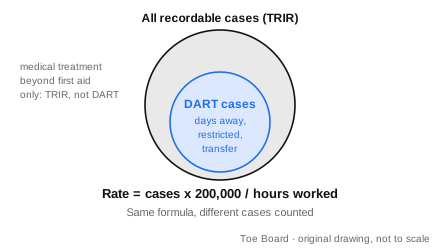
The formula
Both rates use the same shape:
Rate = (number of cases x 200,000) / total hours worked
The 200,000 is 100 full-time workers at 40 hours a week for 50 weeks. It puts a small contractor and a large one on the same scale, so a rate reads as cases per 100 full-time workers per year.
For TRIR, the cases are every case recorded on the OSHA 300 log under Part 1904. For DART, they are only the cases with a check in the days away column or the job transfer or restriction column.
Try one question
Question 1 of the free 10-question check on CHST. No signup.
Emergency Preparedness, Incident Investigation, and Response
On a building under construction, what is the longest allowed travel distance from any point of the protected area to the nearest fire extinguisher?
Choose an answer to begin
A worked example with invented numbers
A contractor's crews worked 400,000 hours in the year. The log shows 6 recordable cases: 2 with days away, 1 with restricted duty and 3 treated with medical care beyond first aid and returned to full duty.
- TRIR = (6 x 200,000) / 400,000 = 3.0
- DART = (3 x 200,000) / 400,000 = 1.5
The three medical-treatment-only cases count in TRIR and not in DART. A case with both days away and restriction counts once.
Ask Kick before you buy AI your Toe Board study buddy
See what's on the CHST exam, test yourself with 5 quick questions, or find the plan that fits you.
The CHST course
Available now · instant accessLearn each CHST blueprint domain, then prove it on two full-length timed practice exams.
- 4modules of lessonsEvery task on the outline
- 2full-length timed exams200 questions in 240 minutes each
- 440practice questionsEach one explained
- 1week-by-week study planSet to your exam date
Turn a practice answer into a study step. In untimed practice, ask Kick AI about any question you answer, follow up, then see your weakest topics and what to drill next.
Instant access. Terms and refunds · Secure checkout by Stripe
Every answer comes with a full explanation.
What the rates do and do not tell you
Both are lagging indicators: they measure harm that already happened. They are useful for comparing years, comparing with industry averages from the Bureau of Labor Statistics, and for owners prequalifying contractors. They say nothing about near misses, which never reach the log, and a small company's rate can swing widely on one case. Pair them with leading indicators such as inspections completed or corrective actions closed, and use the hierarchy of controls to decide what to fix.
Common mix-ups
- Using employees instead of hours. The denominator is hours worked, including overtime, not headcount.
- Counting first aid cases. First aid alone is not recordable, so it is in neither rate.
- Lost time rate vs DART. A lost time case rate counts only days away cases, which is narrower again than DART.
- Rounding too early. Keep full numbers until the last step.
On the CHST exam
Recordkeeping requirements and incident trends are listed under safety program development, implementation and sustainment (22.5%). Practise the rate arithmetic until each step is routine.
Practice it
Run your own numbers through the OSHA incident rate calculator, which gives TRIR, DART and lost time rates with the steps. The recordkeeping guide explains what makes a case recordable. The full term list is in the CHST terms glossary.
Know the terms? Take the free 10-question check
Take the free 10-question check. It covers the four CHST domains, needs no signup and explains every answer, so you see which domain to study first. The CHST study guide shows where each topic fits in a six-week plan.
Not affiliated with or endorsed by BCSP.
Sources
Show the list
- 29 CFR Part 1904, Recording and Reporting Occupational Injuries and Illnesses, OSHA.
- CHST Examination Blueprint (CHST5, V.2022.04.12), Board of Certified Safety Professionals.
Facts checked 26 October 2026 against the sources listed above. If something has changed, tell us and we will correct it within 2 business days.
Your next step
Ready to see where you stand on CHST?
Free, untimed and scored by domain. No signup.
Start the free 10-question checkCHST course. Lessons, timed practice exams and a plan around your exam date. Get CHST course · $149 See the plans or read the free sample lesson.Terms and refunds