Hot work: what it means for the CHST
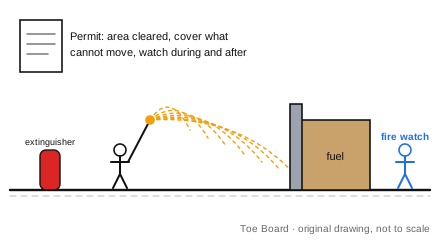
Hot work is any work that produces flames, sparks or enough heat to ignite something: welding, torch cutting, brazing, soldering, thermal spraying and abrasive grinding. On site it is controlled by moving or covering combustibles, keeping an extinguisher at hand, posting a fire watch where needed and, at many employers, issuing a written permit first.
The OSHA rules
Welding and cutting in construction is Subpart J of 29 CFR 1926: gas welding and cutting in 1926.350, arc welding and cutting in 1926.351, fire prevention in 1926.352, ventilation and protection in 1926.353 and work on preserved or coated surfaces in 1926.354. In our own words, 1926.352 asks that objects to be welded be moved to a safe place where practicable, that movable fire hazards nearby be moved or guarded, that suitable fire extinguishing equipment be kept ready, and that extra people be assigned to watch for fire when the normal precautions are not enough, during the work and for long enough afterward.
Gas cylinders bring their own rules in 1926.350: in storage, oxygen cylinders are kept at least 20 feet from fuel gas cylinders or separated by a noncombustible barrier at least 5 feet high with a fire-resistance rating of at least half an hour.
Try one question
Question 1 of the free 10-question check on CHST. No signup.
Emergency Preparedness, Incident Investigation, and Response
On a building under construction, what is the longest allowed travel distance from any point of the protected area to the nearest fire extinguisher?
Choose an answer to begin
Hot work permits
Subpart J does not spell out a permit form, but NFPA 51B is a common reference for permit content. A permit can list the location, the work, the combustibles removed or covered, the fire watch, the extinguisher, any gas testing, and a sign-off before and after. Inside a permit-required confined space, the entry permit also lists any hot work permit, because welding can create the atmosphere hazard on its own.
Ask Kick before you buy AI your Toe Board study buddy
See what's on the CHST exam, test yourself with 5 quick questions, or find the plan that fits you.
The CHST course
Available now · instant accessLearn each CHST blueprint domain, then prove it on two full-length timed practice exams.
- 4modules of lessonsEvery task on the outline
- 2full-length timed exams200 questions in 240 minutes each
- 440practice questionsEach one explained
- 1week-by-week study planSet to your exam date
Turn a practice answer into a study step. In untimed practice, ask Kick AI about any question you answer, follow up, then see your weakest topics and what to drill next.
Instant access. Terms and refunds · Secure checkout by Stripe
Every answer comes with a full explanation.
Fire watch
Subpart J calls for additional personnel assigned to guard against fire (1926.352), with an extinguisher and a way to raise the alarm. Sparks can smoulder inside walls or under floors, which is why the watch continues after the arc stops.
Common mix-ups
- Grinding is hot work. Sparks from an abrasive wheel ignite things too.
- A closed drum is not empty. Containers that held flammables are cleaned and made safe before cutting.
- Coatings can burn or give off toxic fumes. Check the safety data sheet and 1926.354 before heating a coated surface.
- The fire watch does not weld. Splitting the job defeats the purpose.
On the CHST exam
Hot work sits among the hazards in the hazard and risk identification and control domain, 36.6% of the CHST, and fire prevention links to the emergency preparedness, incident investigation and response domain, 19.9%.
Practice it
Our confined spaces guide covers the entry side of hot work in tight spaces. Every term in this set is in the CHST terms glossary.
Know the terms? Take the free 10-question check
Take the free 10-question check. It covers the four CHST domains, needs no signup and explains every answer, so you see which domain to study first. The CHST study guide shows where each topic fits in a six-week plan.
Not affiliated with or endorsed by BCSP.
Sources
Show the list
- 29 CFR 1926 Subpart J, Welding and Cutting, OSHA.
- NFPA 51B, Standard for Fire Prevention During Welding, Cutting, and Other Hot Work, NFPA.
- CHST Examination Blueprint (CHST5, V.2022.04.12), Board of Certified Safety Professionals.
Facts checked 26 October 2026 against the sources listed above. If something has changed, tell us and we will correct it within 2 business days.
Your next step
Ready to see where you stand on CHST?
Free, untimed and scored by domain. No signup.
Start the free 10-question checkCHST course. Lessons, timed practice exams and a plan around your exam date. Get CHST course · $149 See the plans or read the free sample lesson.Terms and refunds